
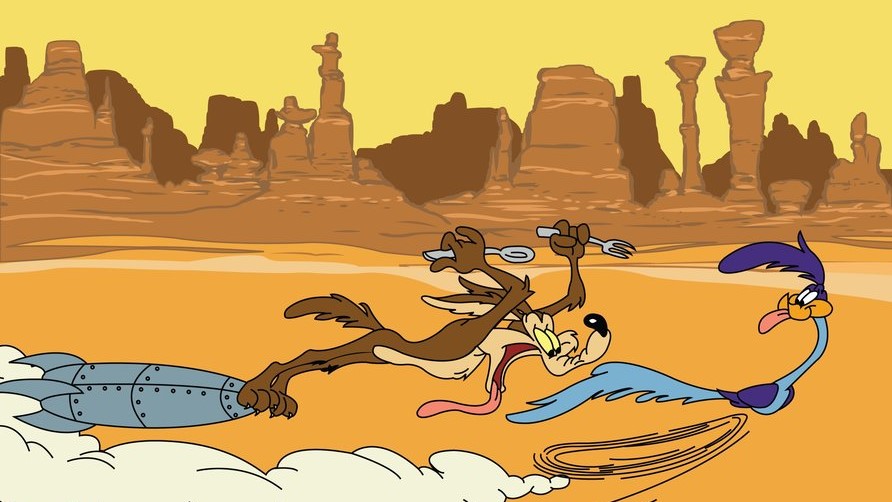
When I was a kid growing up in New England, my only reference point for what the desert is like was Loony Toons cartoons. A funny thing I learned as an adult is that those desert scenes where Road Runner tricked Wile E. Coyote into falling off of cliffs and running into oncoming traffic were actually based on the literal scenery of the American Southwest, especially in Utah and Arizona. Some of them are directly based on real life places, like Monument Valley.
It’s kind of funny now to go back and look at the scenery for those cartoons and be like, “oh yeah, that’s actually what that place looks like.” Luckily I didn’t get squished by a boulder or blown up by my own dynamite while I was there.
I do have to admit that going to southern Utah in August was probably not one of my brightest ideas. Most days it was over 100°F with near-zero percent humidity. Every single day is brutally direct sunshine, without a single cloud, and there are hardly any trees to speak of to provide even a tiny bit of shade. You can’t even look forward to the relief of a cool breeze – when the wind blows it feels like pointing your face into the business end of a hair dryer on full blast. Making it even worse is that all of those smooth rust colored rocks absorb the sun’s heat and radiate it back at you all day and well into the evening. It’s like being in a giant brick pizza oven. The rocks can get so hot that even when the air temperature is around 100, the rocks can get up to 150 or 160 – so hot that climbers and hikers have burned themselves on them!
The first half of my time in Utah I did have some respite from the heat by accidentally booking an Airbnb at high elevation. I stayed in a town called Brian Head, for no other reason than it was somewhat convenient and somewhat affordable. I didn’t realize until I was driving there that I seemed to be going uphill, a lot. I finally figured out what I had done when I saw the sign as I passed into town informing me that I was now nearly 10,000 feet above sea level. In fact Brian Head is the second highest inhabited place in America.
This ended up being both a blessing and a curse; a blessing because I would spend the day in Zion where it was 110°F, and then return to Brian Head where it was 75°F and utter a sigh of relief. But it was a curse in that going up and down five to seven thousand feet of elevation over and over for two and a half weeks was surprisingly hard on my body. There’s 23% less oxygen in the air in Brian Head versus the bottom of Zion Canyon. I spent most of my time there feeling mildly hungover – headache, nausea, and a near-constant nosebleed.
So I was actually relieved to move on to Moab halfway through my time in Utah. The upside is that I was much closer to the parks (in Brian Head I was about a 90 minute drive to both Zion and Bryce, but in Moab I was a mere 15 minutes to Arches), plus Moab is such a delightful little funky town. The downside is that it was over 100°F every day I was there and there was no avoiding it other than staying locked in the AC all day.
It was so hot in Moab that I had to plan my activities around it; hiking in the middle of the day was out of the question, and even attempting to hike in the evening was not a great solution, since the rocks hold the heat so effectively that it can stay in the upper 90s well after the sun sets. I had to plan most of my hikes so that I was done by about 10am.
So I guess if I have one piece of advice about visiting Utah, it would be to not go when it’s blast furnace hot every single day.
Heat aside, I loved Utah as much, and possibly more, than I expected to. It’s so different from any place that I know that sometimes I felt like I was on a different planet from the one I know. And the landscapes are so varied that each area of the state feels like a different planet from each other. I had no idea that red rocks came in so many different, fascinating, and beautiful shapes!
For example:

Zion: Gorgeous towering cliffs containing a desert oasis at the bottom

Bryce Canyon: Stately and mysterious hoodoos

Capitol Reef: A massive ridge in the earth

Canyonlands: A vast maze of unexplored canyons
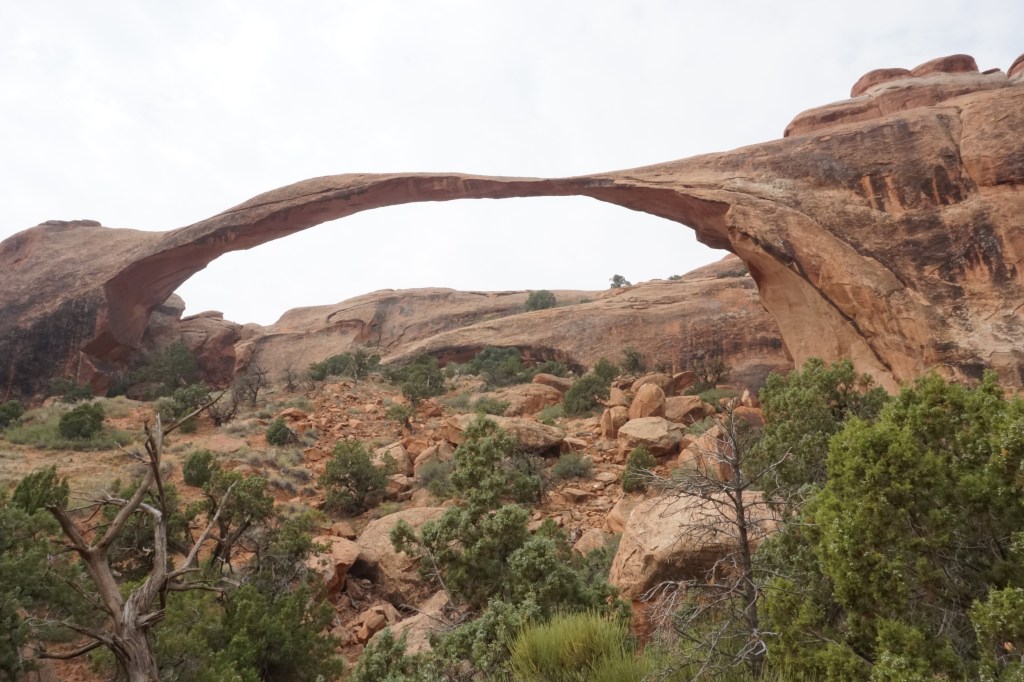
Arches: Fin canyons, balancing rocks, towers of stone, and of course those mysterious and delicate arches
These places are all within 200 miles of each other. In fact the entrance gates for Arches and Canyonlands are only about 15 miles apart.
I love going to places that make me feel small, and the Utah desert does this in so many ways. First, in the scale of their physical size – standing at the bottom of a canyon and looking up at the sheer walls and the wide open sky above you is a good way to remember your place in the universe. But they also do it with the scale in time they represent. These places have all been formed over eons by nothing more than rain and ice and wind. And they’re not done yet; the forces that have shaped them for millennia will go on shaping them for millennia to come. My visit, in fact all of human existence, is just a blink in the arc of their lives.
As always you can read about more of the details of my time in Utah on my photos page. But here are some of my personal highlights:
- Hiking The Narrows in Zion Canyon: What a unique experience to hike a trail that is actually a river. I have photos and more details on my photos page.
- Riding my bike through Zion Canyon: To visit the most popular parts of Zion Canyon you must take the free park shuttle. They let you bring bicycles on the bus, and it’s a steady downhill from the end of the line back to the visitor’s center so biking back is doable in the heat. I did it mostly to avoid being on the shuttle in a pandemic, but this ended up being the best way to see the canyon in detail, mostly free of other people.
- All the sunsets: as beautiful as those red rocks are in full daylight, at golden hour they practically glow.
- Hiking among the hoodoos in Bryce: and getting a prize for it!
- Stargazing in Arches: Speaking of feeling small… The sky here is so dark, especially on a new moon when I went, and so clear that it feels like you can see every single star in the universe. I tried my hand at a little astro photography, but let’s say my skills are a little under developed in that area so sadly I don’t have any to show.
- Hiking to Delicate Arch before dawn: One of the things I had to do in Utah was hike to Delicate Arch (the one from the license plate!) but the hike is so exposed to the sun that hiking during the day is actually dangerous. I only had so many mornings, so I decided to do it on a weekday, which meant going extra early to get back in time for work. I woke up in the pitch black and got to the trailhead just as dawn was starting to break – I actually used a flashlight for the first part of the hike because it was still dark. What an amazing experience it was to see that famous arch just as the sun was appearing over the horizon. If you have the chance to go to Arches and do this trail, absolutely do it.
- Hiking the Devil’s Garden Trail in Arches: Devil’s Garden is an 8 mile trail through the desert that takes you past many of the most famous and dramatic arches and stone formations (including Landscape Arch, which is in the photo above and is over 300 feet wide!) which were all very cool. But the thing that made this hike really special was that the back half of the trail takes you through a series of fin canyons. Climbing over, around and along these unique formations was way more fun than I expected.
- Taking a Jeep 4×4 backcountry tour of Canyonlands: I talk more about this on my photos page, but this was one of my favorite things I did in Utah.
- Celebrating my birthday Moab style: I happened to be in Utah on my birthday in the end of August, and decided to celebrate by going on the Jeep trip, getting a nice hotel with a pool and hot tub, and splurging on a delicious meal at the nicest restaurant in Moab. It was the first birthday I ever spent alone (thanks covid) and it ended up being exactly what I wanted.
On one last note, I’d like to mention that something I’m going to start doing on this blog is acknowledging the indigenous people whose land I’m visiting. I have the great privilege to visit parts of this continent that were inhabited and cared for by Native populations for thousands of years before European settlers arrived – and in most cases, those Native communities were destroyed or driven out by those Europeans. I’ve tried as much as possible to seek out and listen to the stories of indigenous people in all the places I’ve been. The pandemic has disproportionately affected Native communities and as a result I have avoided tribal areas as much as possible; which meant that one of the disappointments of this trip is how little I got to experience and learn from contemporary Native people and culture. I’ve had to rely mostly on learning about their history.
I’d like to be more intentional and aware in my life in general of my participation in colonial culture and white supremacy. A small step I’m taking is to acknowledge the Indigenous people whose (often stolen) land I’m on. You can learn more about territory acknowledgement from Native Land, whose mapping tool I use.
In Southern Utah I was on Southern Paiute, Ute, and Pueblo land. I also visited Northern Arizona, even though I didn’t mention it in this blog post, which is Hopi and Navajo land.




 Alyson Gagne